Make the case. Set the standard.
Whitegate prepares demand letters for California personal-injury firms. From medical chronology and damages to a cited draft on your letterhead, the preparation comes together for your review.
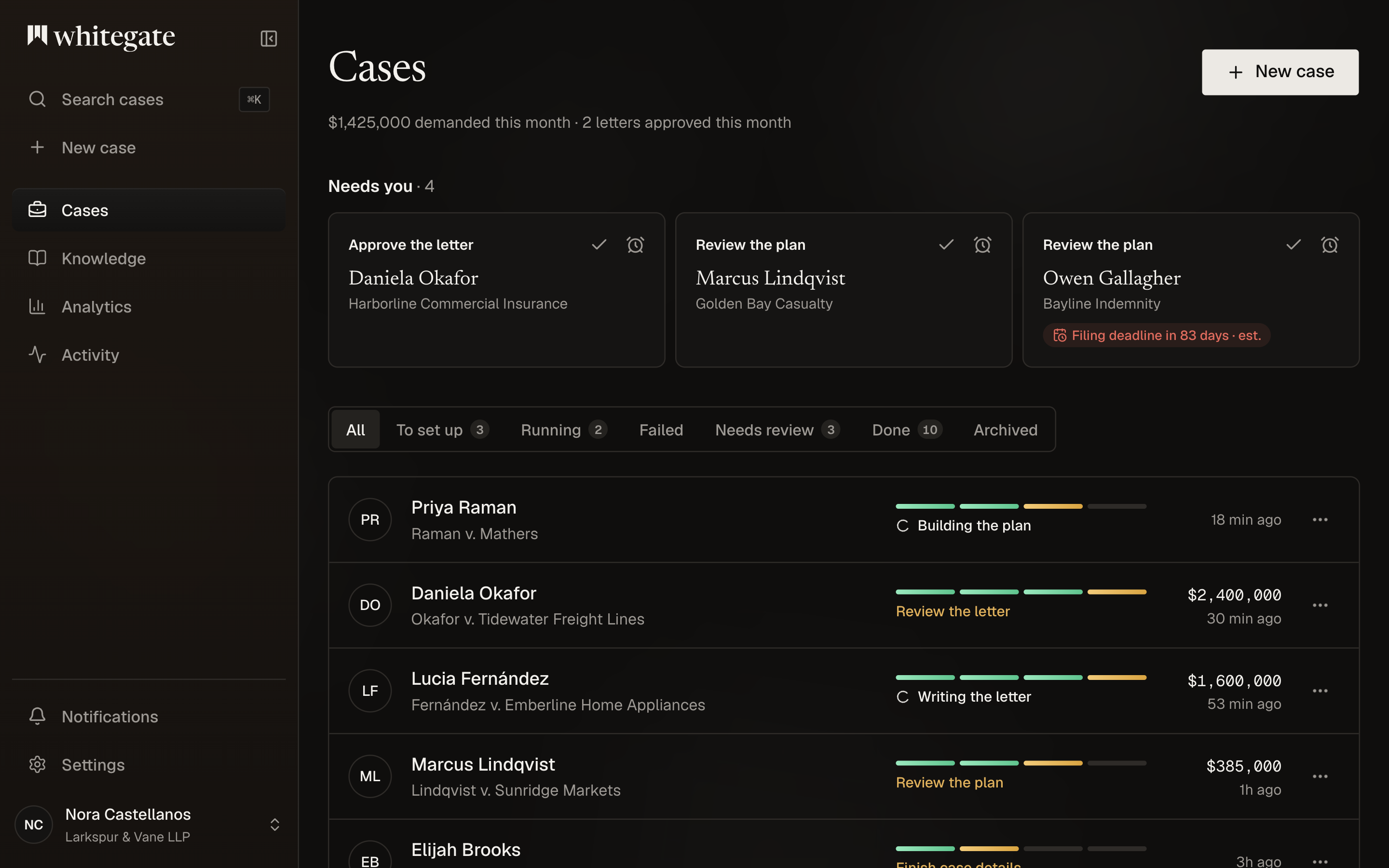
Give every demand the attention it deserves.
Upload the case file and add what the records cannot tell us. Whitegate organizes the medical history, prepares a damages plan and drafts the demand in your firm’s voice.
See the course of care
Medical chronology. Follow the treatment history from the first visit through follow-up care, with references to the underlying records.
Know what supports the number
Review the damages, the recommended amount and the weak spots together. Decide what to demand with the reasoning in view.
Put your name to your work
A draft shaped by your firm’s writing and presented on your letterhead. Yours to review, edit and approve.
Carry the work through
Record when you sent the demand and when a response is due. Keep the next conversation in view after the letter leaves your desk.
Your demand draft. Within the hour.
Average processing time is under an hour. Timing varies with file size and complexity; attorney review time is additional.
You decide.
The preparation moves forward. The judgment stays with you.
Review the plan before the letter is written. Question the reasoning, adjust the amount and approve the direction. Then review the draft before you put your name to it.
Prepare
The record becomes a cited plan
Decide
You review the reasoning and approve the direction
Refine
The demand is drafted for your review and approval
The complete demand package.
The draft, the exhibits and the preparation behind the number, brought together for your review.
The demand letter
A draft on your letterhead, in Word and PDF. Review the language before it represents your firm.
Stamped exhibits
Numbered, stamped exhibits to accompany the demand and make its supporting records easier to locate.
Itemized damages
See how the amounts are built and where they come from before you approve the demand.
A short review list
Open questions and points to double-check, brought into view before your final approval.
An argument you can trace to the record.
A persuasive sentence still needs support. Follow citations back to the source page and inspect the underlying record as you review the draft.
Choose a sentence with a note to open its source.
On March 3, a Coastline Freight tractor-trailer struck the rear of Ms. Rivera's car while she was stopped at a red light on Interstate 5. An MRI at St. Example Medical Center showed a large L4-L5 disc extrusion compressing the left L5 nerve root.1 On June 9, she underwent an L4-L5 fusion at Example Spine Institute.2
Her past medical expenses total $412,380.3 Her surgeon expects further treatment, including injections and a possible revision.
Showing St. Example Medical Center, MRI report, Ex. 4, p. 12.
Security is part of the brief.
Your review of Whitegate should include how it handles sensitive records. Start with the safeguards, processing details and limitations in the security overview.
A documented security approach
Review the security overview for the safeguards and their scope.
Encrypted, in storage and in transit
Case files are encrypted at rest in a private bucket and travel only over encrypted connections.
Sign-in without a password
Sign in with a passkey or a one-time email code.
Access by invitation
Share a case with invited collaborators. Case permissions govern access.
Accountable access
File views, downloads and account security events are recorded in the audit log.
Know how AI processes the file
The security overview identifies the AI providers and explains how case data is processed.
See what your next demand could look like.
Walk through a sample case, examine the supporting evidence and review the finished draft.
Request a demo